
SUVAT - Distance, Initial Velocity, Final Velocity, Acceleration, Time
SUVAT is an acronym derived from the equations of motion. There are three, or four, or five equations of motion depending on which textbook you consult or which teacher you ask. I will write five to be comprehensive.
 (1)
(1)
 (2)
(2)
 (3)
(3)
 (4)
(4)
 (5)
(5)
The suvat method is to write down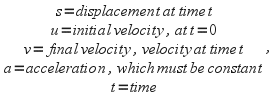 and fill it out as much as possible with the quantities you are given. You should then choose from the equations (1) to (5) choose which one which will enable you to calculate the required quantity, or at least one quantity you don't yet have, upon which you may be able to find the required quantity using a second equation and the quantity you have just found.
Three things must be kept in mind. are all vectors. Each has a magnitude and direction. It will help to use the normal conventions that up and right are positive, down and left are negative.
 is a scalar. We are usually interested only in those values ofwhich are greater than 0. Any value ofless than 0 will probably be a fictitious solution and is usually discarded.
For projectiles, using the convention that up is positive and down is negative, the acceleration is always -9.8( )
)
Example: A ball is thrown vertically up with a speed of 15m/s from a point 3m above the ground. Find the velocity it has when it hits the ground and the time for which it is in the air.

We have and want to find
 We can use (2)

We have taken the negative square root because the ball is moving down.
Now we have

Use (3) to find


