The fundamental equation connecting capacitance, voltage and charge is
Charge=Voltage*Capacitance (1)
If a battery is connected to a capacitor, the voltage across the capacitor will not instantly become the battery voltage. Instead current will flow in the circuit. Negative charge will collect on one plate and positive charge on the other. The voltage across the capacitor will build up and as it does the voltage available to drive the current through the internal resistance of the battery will decrease. Eventually after an infinite time, the voltage across the capacitor will reach the battery voltage and no current will flow. At each point during the charging of the capacitor equation (1) is obeyed. We can also related the voltage across the capacitor to the time elapsed since the battery was connected: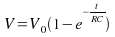 where
where is the emf of the battery.
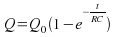
But then (1) gives the charge across the capacitor at any time since if we multiply both sides by
 we obtain
 where
where is the charge stored on the fully charged capacitor.
We can also find the current in the circuit at any time by differentiating
 obtaining
 (2)
(2)
Now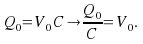 Substituting this into (2) gives
But is the initial current
 so
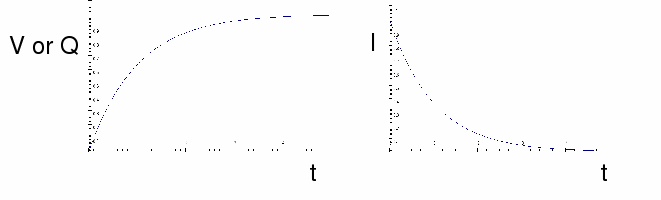
so  The qualitative graphs of
 and
and are shown below.
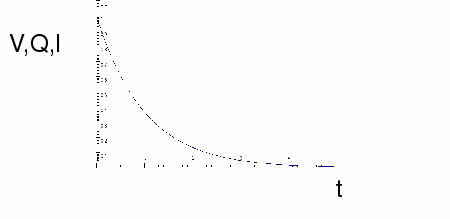
Similar arguments give the analogous equations for discharging capacitors.
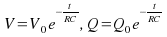 and
and The qualitative graph of V,Q and I against t is shown below, indicating exponential decay.