


In the absence of air resistance any body falling freely under gravity falls with a constant acceleration of A graph of speed against time is shown below for the situation where there is no air resistance. The velocity increases by
 for every second that passes.
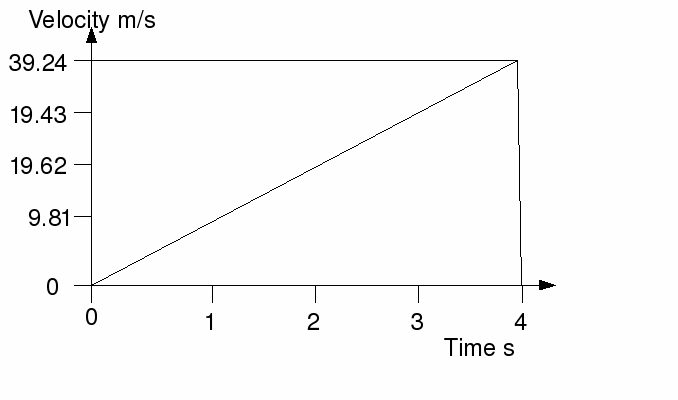
The acceleration above is equal to the gradient of the graph = The only force acting on the object whose motion is shown above is gravity. In reality gravity is not the only force acting. Air resistance is a force acting on any falling body – in fact any body moving through the air – and the force of air resistance increases as the velocity increases. The diagram below shows a parachutist falling.
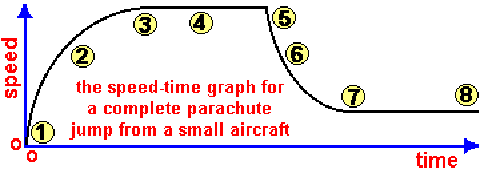
-
The parachutist jumps from the aircraft. He parachute is closed and the is no air resistance acting vertically.
-
As the parachutist starts to accelerate the force of air resistance starts to increase. His speed is increasing but his acceleration is slowing.
-
As the parachutist falls faster the air resistance increases more. The acceleration is decreasing to zero.
-
The force of gravity equals the force of air resistance. There is no resultant force and the parachutist is not accelerating.
-
The parachutist opens his parachute. The force of air resistance shoots up but the force of gravity stays the same. The parachutist starts to decelerate rapidly.
-
As the parachutist slows down the force of air resistance decreases. The resultant force decreases, hence the gradient of the graph and the acceleration both decrease.
-
The force of air resistance now equals the force of gravity. The parachutist is falling with a constant speed – he has reached his terminal velocity.
-
The parachutist falls with a constant speed until he reaches the ground.