


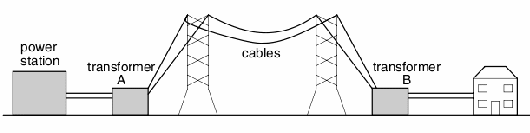
When electricity is generated, it has to be transmitted to people's homes. Often it has to happen over long distances. It is inefficient to transmit energy at ordinary household voltages – maybe 240V – over long distances.
This is because the power dissipated in the wires is (1). A low transmission voltage means a large current hence large power losses. Suppose the power station can generate
 then the current supplied is
 Then Using (1) above the power dissipated in the wires is
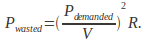 Since
Since is given, increasing the transmission voltage decreases power losses in transmission. If we step up the voltage then the current and the power losses are reduced. Before it reaches people houses, the voltage must be transformed down to the normal, safer, household voltage of 340V.
Example: A power line has a resistance of Find the voltage drop and power losses when 55KW is transmitted and the transmission voltage is
a)240V
b)22000 V
a)

b)

In order to minimise power losses during transmission, the voltage is transformed up at A in the diagram above, and down at B for transmission into people's homes.